

Lease preparation
Streamline your lease preparation
%3bfill-opacity:.38'/%3e%3cpath fill-rule='evenodd' clip-rule='evenodd' d='M29.255 13.678H15.986c-.977 0-1.77.709-1.77 1.583v11.221H25.88c.85 0 1.433.713 1.421 1.423-.008.568.073 1.223.378 1.71.148.236.346.428.613.56.105.05.224.095.361.128h.602c.977 0 1.77-.71 1.77-1.584V15.261c0-.874-.793-1.583-1.77-1.583Zm-2.144 16.625a2.468 2.468 0 0 1-.195-.27c-.429-.684-.509-1.523-.5-2.14.006-.335-.268-.585-.536-.585H14.217v1.411c0 .875.792 1.584 1.769 1.584h11.125Z' fill='%23009EFF' style='fill:color(display-p3 0 .6196 1)%3bfill-opacity:1'/%3e%3crect x='17.755' y='20.011' width='9.731' height='.792' rx='.396' fill='white' style='fill:white%3bfill-opacity:1'/%3e%3crect x='20.409' y='16.844' width='7.077' height='.792' rx='.396' fill='white' style='fill:white%3bfill-opacity:1'/%3e%3crect x='21.294' y='23.178' width='6.192' height='.792' rx='.396' fill='white' style='fill:white%3bfill-opacity:1'/%3e%3crect x='17.755' y='23.178' width='2.654' height='.792' rx='.396' fill='white' style='fill:white%3bfill-opacity:1'/%3e%3cpath fill-rule='evenodd' clip-rule='evenodd' d='M15.693 30.854c-2.684 0-3.833-1.863-4.29-3.032-.186-.476.215-.927.757-.927h13.72c.558 0 .987.482.979 1.004-.019 1.186.323 2.987 2.592 2.878-4.644.162-9.843.076-13.758.076Z' fill='%23009EFF' style='fill:color(display-p3 0 .6196 1)%3bfill-opacity:1'/%3e%3c/svg%3e)
Tenancy management
For a good tenant relationship

Lease termination
End leases legally and smoothly

' fill='%23E9F0FA'/%3e%3crect opacity='.39' width='228.538' height='284.447' rx='10' transform='matrix(-.96315 -.26897 -.26927 .96306 314.707 85.06)' fill='%23E9F0FA'/%3e%3cg filter='url(%23a)'%3e%3crect x='20.234' y='16' width='228.877' height='284.494' rx='10' fill='url(%23b)'/%3e%3c/g%3e%3crect x='55.996' y='138.918' width='154.492' height='3' rx='1.5' fill='%23E9F0FA'/%3e%3crect x='55.996' y='168.918' width='154.492' height='3' rx='1.5' fill='%23E9F0FA'/%3e%3crect x='55.996' y='198.918' width='154.492' height='3' rx='1.5' fill='%23E9F0FA'/%3e%3crect x='91' y='239' width='88' height='3' rx='1.5' fill='%23E9F0FA'/%3e%3cdefs%3e%3clinearGradient id='b' x1='388.584' y1='650.035' x2='42.732' y2='7.248' gradientUnits='userSpaceOnUse'%3e%3cstop stop-color='%23F7FAFF'/%3e%3cstop offset='1' stop-color='white'/%3e%3c/linearGradient%3e%3cfilter id='a' x='.234' y='0' width='268.879' height='324.494' filterUnits='userSpaceOnUse' color-interpolation-filters='sRGB'%3e%3cfeFlood flood-opacity='0' result='BackgroundImageFix'/%3e%3cfeColorMatrix in='SourceAlpha' values='0 0 0 0 0 0 0 0 0 0 0 0 0 0 0 0 0 0 127 0' result='hardAlpha'/%3e%3cfeOffset dy='4'/%3e%3cfeGaussianBlur stdDeviation='10'/%3e%3cfeColorMatrix values='0 0 0 0 0.827604 0 0 0 0 0.876287 0 0 0 0 0.945833 0 0 0 0.47 0'/%3e%3cfeBlend in2='BackgroundImageFix' result='effect1_dropShadow_8355_25104'/%3e%3cfeBlend in='SourceGraphic' in2='effect1_dropShadow_8355_25104' result='shape'/%3e%3c/filter%3e%3c/defs%3e%3c/svg%3e)
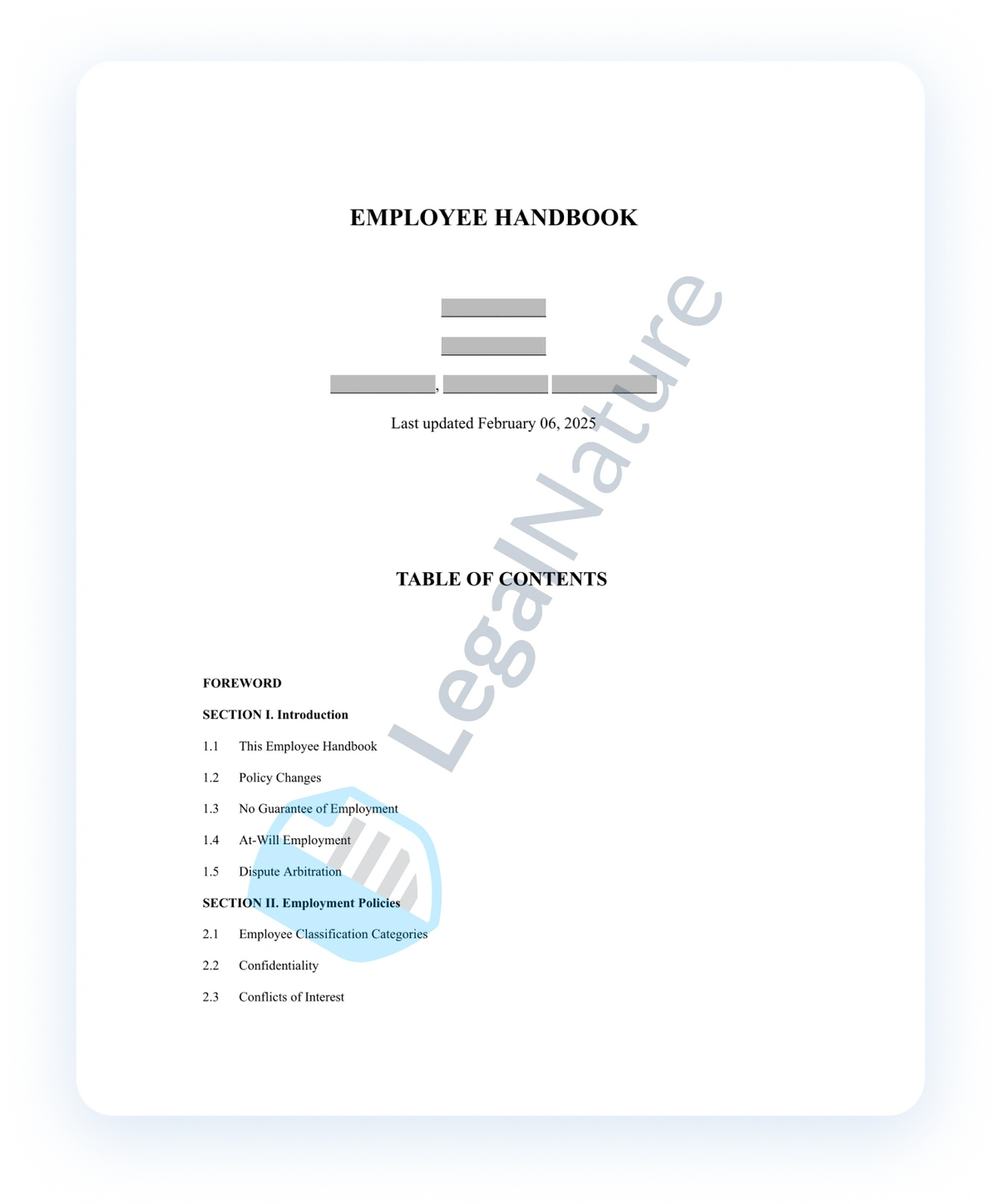
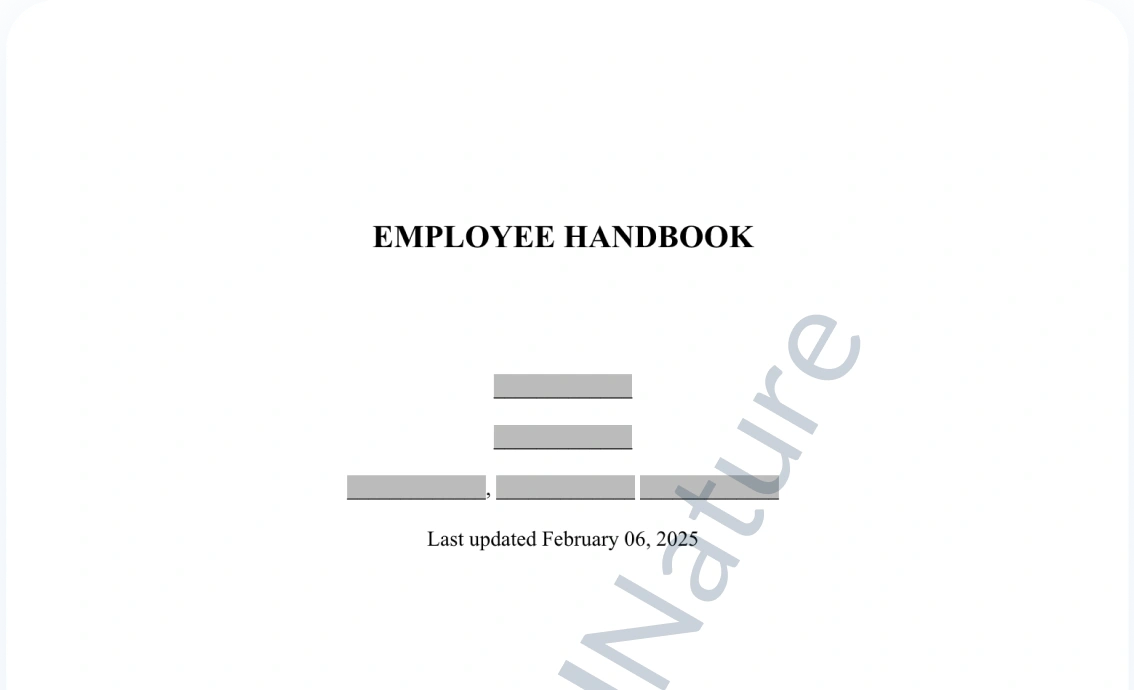
What is an employee handbook?
An employee handbook is a critical document that outlines a company's policies, expectations, and culture while ensuring legal compliance and fostering clear communication. It serves as a foundational guide for employees, providing essential information about workplace standards, benefits, and procedures. These are often accompanied by a form which employees must sign to verify that they have read and understand the policies contained therein.
Create related business infrastructure documents
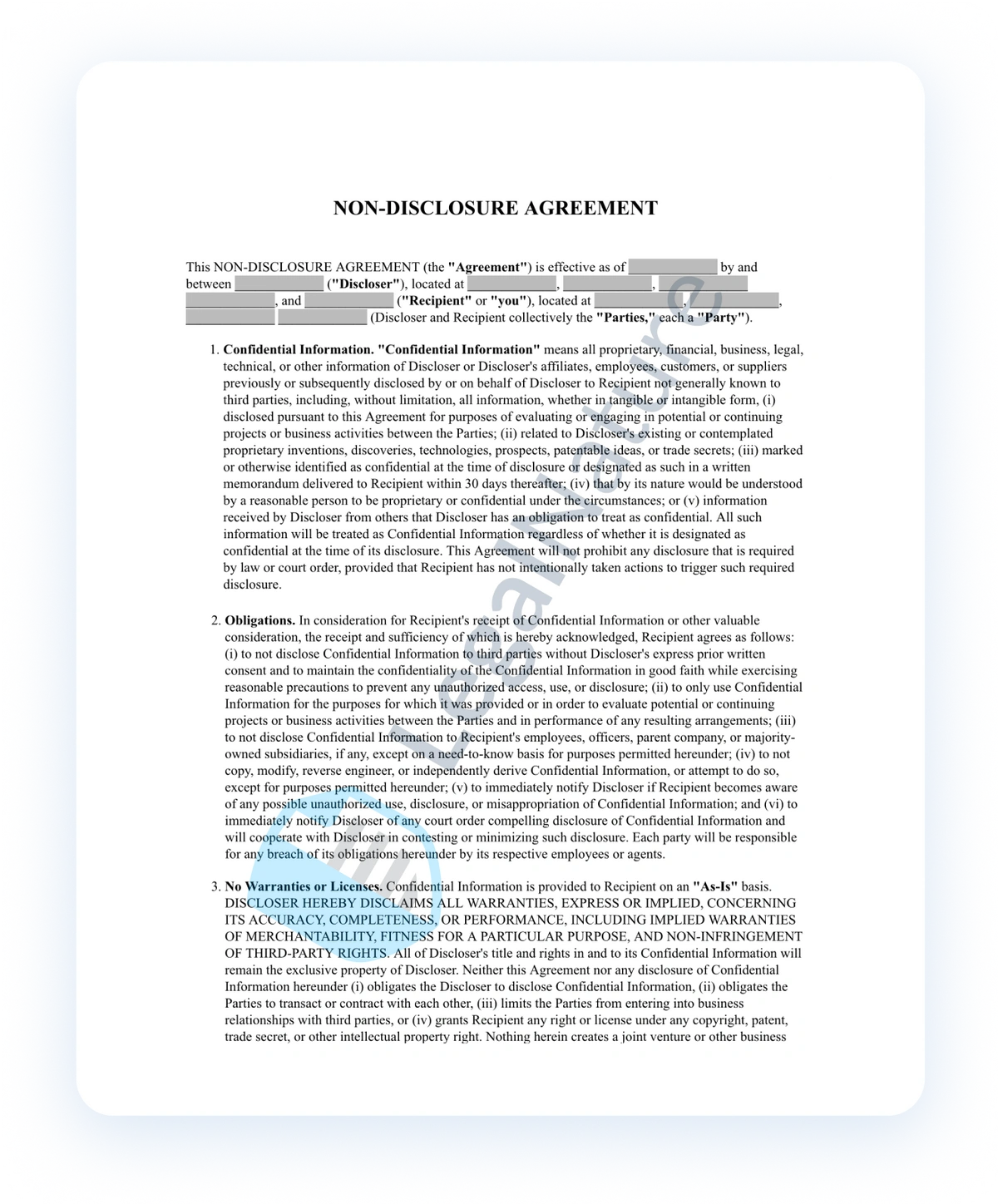
Employee NDA The best way to safeguard the company's confidential information and trade secrets from theft or unauthorized disclosure.
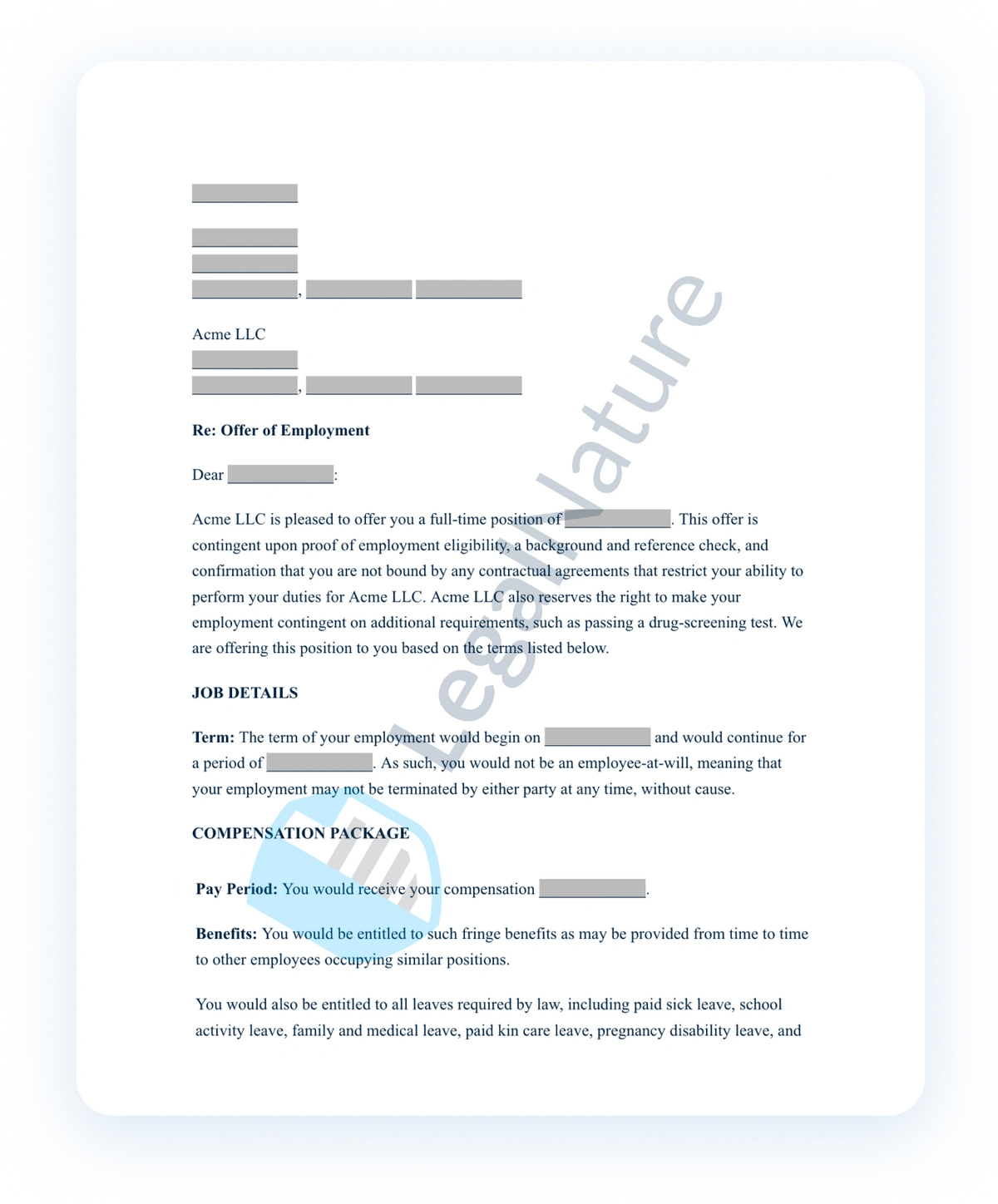
Job Offer Letter Notify a potential employee about a job offer and specify all the relevant details of employment.
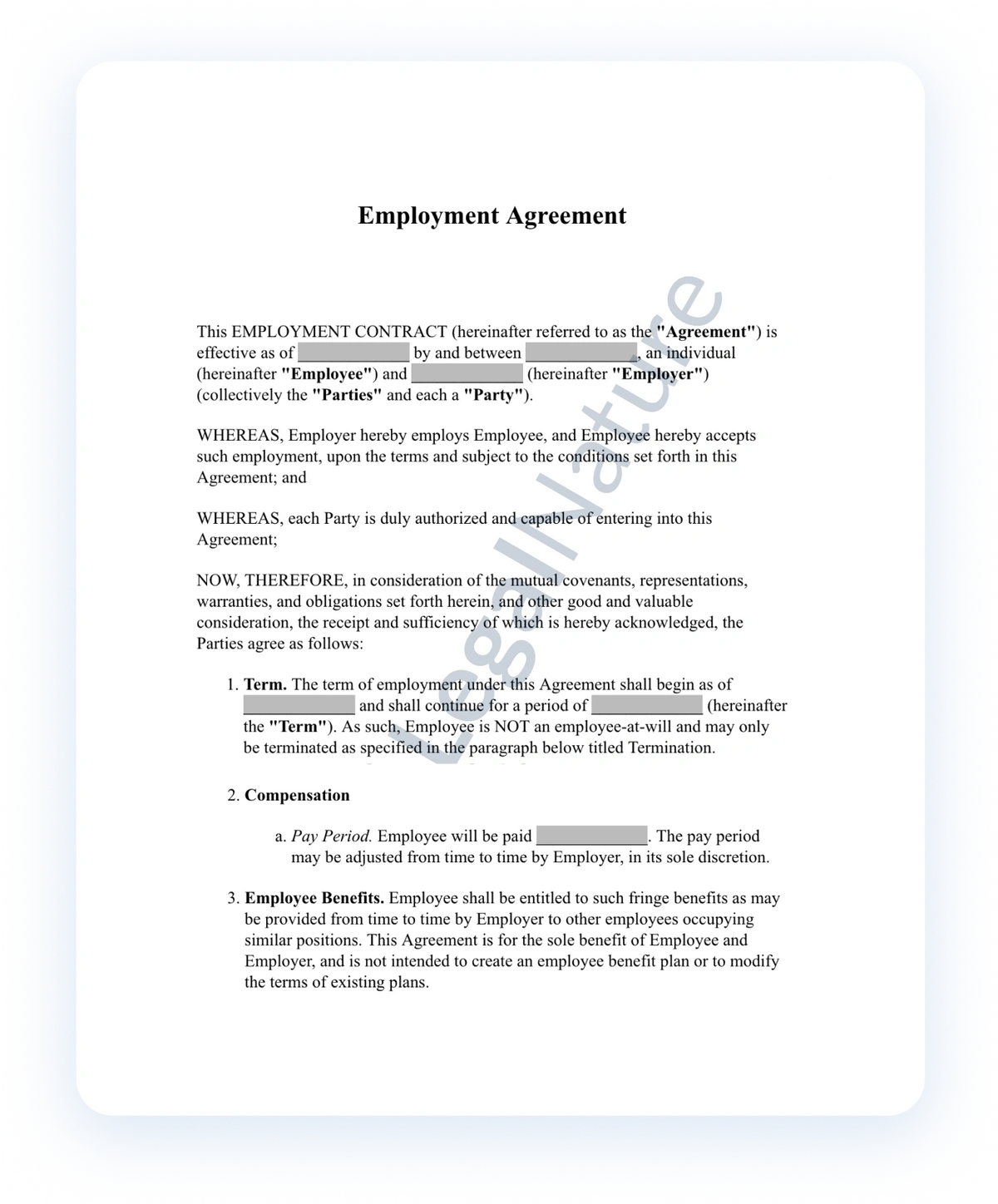
Employment Contract Establish the goals, expectations, and financial benefits that make up the relationship between the employee and employer.
Create an employee handbook in your state
- Alabama
- Alaska
- Arizona
- Arkansas
- California
- Colorado
- Connecticut
- Delaware
- District of Columbia
- Florida
- Georgia
- Hawaii
- Idaho
- Illinois
- Indiana
- Iowa
- Kansas
- Kentucky
- Louisiana
- Maine
- Maryland
- Massachusetts
- Michigan
- Minnesota
- Mississippi
- Missouri
- Montana
- Nebraska
- Nevada
- New Hampshire
- New Jersey
- New Mexico
- New York
- North Carolina
- North Dakota
- Ohio
- Oklahoma
- Oregon
- Pennsylvania
- Rhode Island
- South Carolina
- South Dakota
- Tennessee
- Texas
- Utah
- Vermont
- Virginia
- Washington
- West Virginia
- Wisconsin
- Wyoming
When to create an employee handbook
An employee handbook sets forth a business's rules and policies in one accessible place for both employees and management alike. Some states require the development of an employee handbook, while others do not; however, it is important to create an employee handbook to avoid confusion and set employee expectations. After a company has been registered with a state, it is crucial to build an organized and clearly-written employee handbook.
Create your employee handbook in 3 steps
Gather Information
As you complete your employee handbook, you will need to provide certain relevant information. This includes, but is not limited to, the employer's business address, current number of employees, and policies concerning break time, employee benefits, and taking time off. It may help to discuss these items with your director of human resources and other key personnel.
Complete Our Short Questionnaire
Use the information you collected to complete the employee handbook. We make this easy by guiding you each step of the way and helping you to customize your document to match your specific needs.
Review and Distribute
It is always important to read your document thoroughly to ensure it matches your needs and is free of errors and omissions. After reviewing, print a copy of the handbook for each employee and have him or her sign the employee acknowledgments page. Be sure to retain a copy of this page in each employee's personnel file.
Why create an employee handbook?
An employee handbook is a critical tool for a business to communicate and establish its workplace policies and culture, protect its legal interests, and streamline its onboarding processes. An employee handbook provides your employees with notice of the crucial policies and procedures that they must follow during their employment. Providing employees with this notice can serve to protect your company's legal interests and help to prevent unlawful termination or other employment-based lawsuits. A handbook also eases new employees' transitions into your company culture.

Why choose LegalNature?
LegalNature offer the guidance to navigate the nuances of creating an employee handbook across all 50 states. LegalNature offers a 30-day money-back guarantee. If you're not happy, then we’re not happy. Give us a call and let us help.
Employee handbook guide
An employee handbook is designed to help you create comprehensive, state-specific employment policies that are customized to your company's needs. Our handbook includes legally mandated policies concerning payroll, sick leave, paid time off, overtime, benefits, breaks, and jury duty. It also covers vital company policies as well as the protection of confidential information and trade secrets. The following is a brief breakdown of the key components included in our employee handbook:
Company Information
When selecting the state of employment, remember that employment law varies drastically between states. This means that you will need to create a separate employee handbook for each state where your company has employees. The effective date will be the official date that the policies in this handbook become effective as to the employees receiving a copy and signing the acknowledgment on the last page. Usually, you are safe entering today's date for the effective date.
Company Policies
Our handbook automatically includes standardized employee policies including dress code, performance reviews, smoking policy, computer use policy, social media policy, and work from home policy. You also have the option of providing your own customized internal policies to govern employee conduct.
Payroll Information
In compliance with labor law requirements in your state of employment, our handbook allows you to make informed provisions regarding employee payroll frequency and payment methods.
Meal and Rest Breaks
An employee handbook should include information regarding the minimum amount of any meal or rest breaks required by your state. If your state requires one or both of these, your company may still allow more than the state minimum. If your state does not require these, then the form builder will give you the option of allowing these breaks.
Benefits Offered
Besides health insurance and workers' compensation insurance, most benefits are typically discretionary. Federal law requires employers with 50 or more employees to provide health insurance to full-time employees, and state law may impose requirements on smaller employers. Likewise, workers' compensation insurance is typically required for all employers under their respective state laws unless they are very small or some other special exemption applies. Be sure to check your state laws if you think you may be exempt from providing these benefits.
Sick Leave
Several states and localities have varying sick leave requirements for private employers, depending on the employer size. Our handbook automatically captures the required sick leave provisions in every state of employment. Nevertheless, employers are free to offer sick leave in excess of the minimum amount required by law.
Family and Medical Leave Programs
Under Federal law, employers that are subject to the Family and Medical Leave Act (FMLA) are required to provide unpaid leave for certain medical situations.
If a state provides an employee with more generous benefits than the FMLA, employers are required to follow the state law. Applicable state family and medical leave requirements are automatically captured in the handbook.
Probationary Period
Our handbook gives you an option to include a probationary period in the handbook. Probationary periods can help employers evaluate the performance and suitability of new employees. They can also be used for the purpose of determining when employees may begin accruing benefits.
Create your employee handbook in minutes
Complete our form
Preview and download your document
Review and sign your document